
Documento-Fibrosis Pulmonar
Secuelas pulmonares de COVID-19: Enfoque en la enfermedad pulmonar intersticial
Although pirfenidone slows disease progression in patients with idiopathic pulmonary fibrosis (IPF), in clinical practice, patients often cannot tolerate the recommended dose because of several adverse events. This study aimed to investigate adverse events associated with pirfenidone and factors associated with dose reduction…
Factors associated with dose reduction of pirfenidone in patients with idiopathic pulmonary fibrosis: A study based on realworld clinical data.
Although pirfenidone slows disease progression in patients with idiopathic pulmonary fibrosis (IPF), in clinical practice, patients often cannot tolerate the recommended dose because of several adverse events. This study aimed to investigate adverse events associated with pirfenidone and factors associated with dose reduction…

Pirfenidona en la neumonitis fibrótica por hipersensibilidad: un ensayo clínico aleatorizado doble ciego de eficacia y seguridad.
La neumonitis por hipersensibilidad (NH) es una forma inmunológicamente mediada de enfermedad pulmonar, resultante de la exposición por inhalación a una gran variedad de antígenos. En los Estados Unidos, la prevalencia anual estimada de NH oscila entre 1.67 y 2.71 casos por cada 100 000 personas. Entre el 56% y el 68% de los casos de NH cada año se consideran enfermedad crónica y entre los casos crónicos, aproximadamente el 36%-48% tienen una presentación con fibrosis pulmonar. Una gran proporción de pacientes con Neumonitis fibrótica por hipersensibilidad (NFH) desarrollan progresión sintomática, funcional y radiográfica de la enfermedad.
Idiopathic pulmonary fibrosis in the United States: time to diagnosis and treatment.
Idiopathic pulmonary fibrosis (IPF) is the most common type of fibrosing interstitial lung disease affecting an estimated 2.8–9.3 cases per 100,000 people per year. Onset generally occurs in the 7th decade of life. Traditional risk factors include age, male gender, tobacco use history, and family history….
Expectations, symptoms, and quality of life before and after 1 year of Pirfenidone treatment in patients with idiopathic pulmonary fibrosis: A single‐arm, open‐label nonrandomized study.
Antifibrotic therapies reduce lung function decline in patients with idiopathic pulmonary fibrosis (IPF). This single‐arm, open‐label, nonrandomized study aimed to determine the influence of antifibrotic treatment on patients’ reported symptoms and expectations of the therapy.
Antifibrotic Therapies and Progressive Fibrosing Interstitial Lung Disease (PF-ILD): Building on INBUILD.
Progressive fibrosing interstitial lung disease (PF-ILD) describes a phenotypic subset of interstitial lung diseases characterized by progressive, intractable lung fibrosis. PF-ILD is separate from, but has radiographic, histopathologic, and clinical similarities to idiopathic pulmonary fibrosis. Two antifibrotic medications, nintedanib and pirfenidone, have been approved for use in patients with idiopathic pulmonary fibrosis…
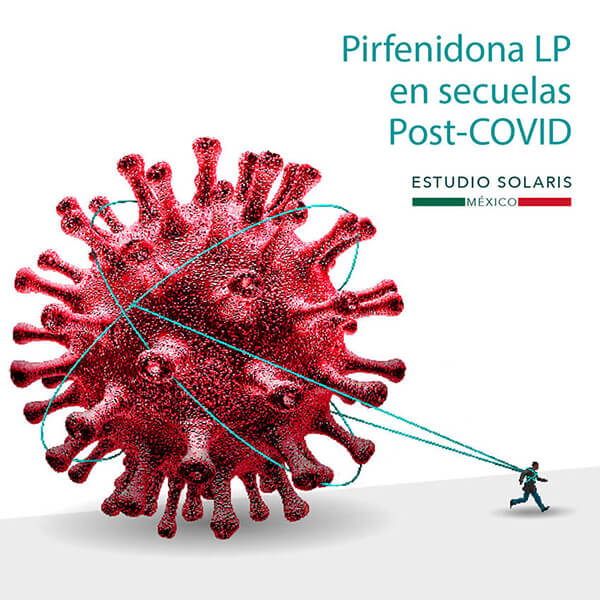
Infografía – Estudio Solaris. Pirfenidona LP en secuelas Post-COVID.
Autor: Fecha de Publicación: Editorial:
Pharmacokinetic evaluation of two pirfenidone formulations in patients with idiopathic pulmonary fibrosis and chronic hypersensitivity pneumonitis.
Lorem ipsum dolor sit amet, consectetur adipiscing elit. Ut elit tellus, luctus nec ullamcorper mattis, pulvinar dapibus leo. Autor: Fecha
The Interaction Between Pulmonary Fibrosis and COVID-19 and the Application of Related Anti-Fibrotic Drugs.
Lorem ipsum dolor sit amet, consectetur adipiscing elit. Ut elit tellus, luctus nec ullamcorper mattis, pulvinar dapibus leo. Autor: Fecha
Pulmonary Fibrosis in COVID-19 Survivors: Predictive Factors and Risk Reduction Strategies.
Lorem ipsum dolor sit amet, consectetur adipiscing elit. Ut elit tellus, luctus nec ullamcorper mattis, pulvinar dapibus leo. Autor: Fecha
Role of pirfenidone in TGF‑β pathways and other inflammatory pathways in acute respiratory syndrome coronavirus 2 (SARS‑CoV‑2) infection: a theoretical perspective.
Lorem ipsum dolor sit amet, consectetur adipiscing elit. Ut elit tellus, luctus nec ullamcorper mattis, pulvinar dapibus leo. Autor: Fecha

